Your climbing journal: projects, photos and a level that means something
The climbing journal keeps your sends, projects and photos in one place, and turns your hardest recent climbs into a level on the IRCRA scale that you can actually compare over time.
Coach Lucian · · updated · 3 min read

Training logs tell you how hard you worked. They do not tell you how well you climbed. For that you need a different record: the climbs themselves. That is what the climbing journal in Train Climb is for.
Boulders and routes, in their own grades
You can log both boulders and routes. Boulders use the Font scale (6A, 7B+ and so on) and routes use the French scale (6b, 7a+ and so on), which are the systems most climbers in Europe already think in.
For each climb you record:
- The name, crag or gym, and the grade.
- Whether you sent it, and how: onsight (first try, no beta), flash (first try, with beta) or redpoint (after practice).
- Or whether it is still a project you are working on.
- Photos, if you want them. A picture of the topo, the crux hold or you on the line makes the entry far more memorable.
Projects are worth logging even before you send them. A list of projects with notes from each session ("left heel works on the second bolt", "skin too thin today") is a surprisingly good training tool in its own right, and the day you mark it as a redpoint is a good day.
A level that means something
Grades are messy. A 7a at one crag is not the same as a 7a at another, and comparing a boulder grade with a route grade is mostly guesswork. Your best ever send can also be a poor guide to where you are now, especially after an injury or a long break.
Train Climb handles this in two ways.
First, it converts grades to the IRCRA scale, a numerical reporting scale proposed by Draper and colleagues (2015) for the International Rock Climbing Research Association. It was designed so that researchers could compare climbing ability across different grading systems on one continuous scale. It is not perfect, and grade conversions are always approximate, but it is a well-recognised and sensible common ground.
Second, your level is the average of your five hardest sends in the last 90 days. That has a few useful consequences:
- One lucky send on a soft grade does not inflate your level much.
- Your level reflects how you climb now, not three years ago.
- It rises when you consistently send harder, which is exactly what you want to measure.
- Projects do not count until they are sent, so the level stays honest.
Your level is not a judgement of you as a climber. It is a moving snapshot of your recent best, on a scale that lets you compare like with like.
Why it helps your training
Putting the journal next to your session log answers questions that neither can answer alone. If your training load has been steady for two months and your level is creeping up, the plan is working. If load has climbed sharply but your level has stalled, it might be time to rethink the balance between training and actually climbing, or to look at recovery. Our posts on why tracking your training matters and moving from plastic to rock explore this further.
For coaches, the journal shows what athletes are trying, not just what they are training. A coach who can see that an athlete has three steep overhanging projects can plan sessions that actually support them. Coaches can also message athletes about a specific climb, which keeps the conversation attached to the route rather than lost in a chat.
Tips for a useful journal
- Log sends the same day, while the details are fresh.
- Be honest about style. If you had beta, it was a flash, not an onsight.
- Use the grade you agree with, within reason, but do not downgrade everything out of modesty either. Consistency matters more than precision.
- Add a photo to projects, so you remember the line when you come back months later.
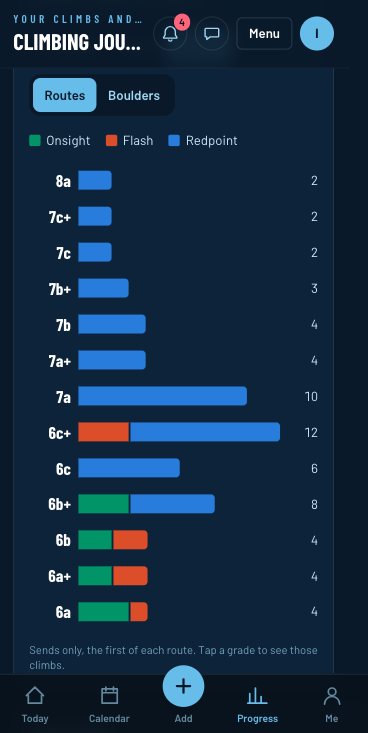
In Train Climb
- Open the journal and add your five hardest sends from the last three months to see your current level.
- Add one project you are working on, with a note about the crux.
- Next time you visit the crag or gym, log every send and project before you leave.
- After 90 days, compare your level with today. That comparison is often more motivating than any single grade.